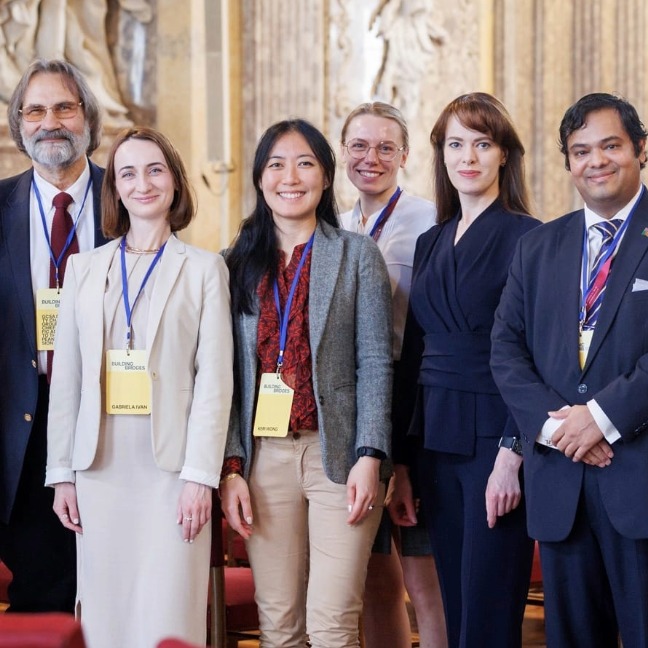
Sandeep Sandhu: How cross-sectoral collaboration can solve our biggest challenges
UK Young Academy podcast | Season 1 | Episode 5
Join the leaders of tomorrow on the UK Young Academy podcast. Hear from members working across disciplines and sectors as they share their journeys, the highs and lows of their careers, and what drives them to make a difference.

In this penultimate episode of season 1 of the UK Young Academy podcast, Sandeep Sandhu, the Executive Director at Innovate UK Business Connect, shares her journey from research to innovation and the importance of collaboration across academia, industry, and government.
She discusses her involvement in science and technology diplomacy through her UK Young Academy project and the challenges and successes she’s experienced in developing these initiatives. Sandeep emphasises the need for interdisciplinary collaboration and networking, and shares her aspirations for the future of the UK Young Academy.
Learn more about Sandeep and connect:
Transcript
Please note that these transcripts have been automatically generated and may feature errors.
UK Young Academy Team (01:06)
I’m Alistair McConnell. Welcome to the UK Young Academy podcast. And here today, we are really lucky to be joined by Sandeep, if you’d like to give yourself a bit of an introduction.
Sandeep (01:18)
Yes, so hi everyone. I’m Sandeep Sandhu. I am the current Executive Director at Innovate UK Business Connect and I look after a quite large portfolio of our global activities, looking at research and insights and the policy work that we lead on. Also looking at private sector investment into innovation in the UK.
and also building our strategic partnerships both nationally and also globally. So I work across quite a broad area in research and in innovation.
UK Young Academy Team (01:51)
I will say that that is quite a fascinating job that you have. I really broad, as you said as well. Can you tell us a little bit actually about your background and how that got you into what you’re doing currently?
Sandeep (02:03)
Yeah, of course. So I was a researcher a long, long ago. And so I of firsthand the importance of research, but how that also can move along this pipeline and be translated into sort of providing solutions to some of the challenges we face. So I was working in diagnostics, developing solution for detecting Ebola at the time, which was a big
emerging disease that was breaking out across Africa or regions of Africa and looking at how to develop this diagnostic tool. And now it’s actually being adopted in some areas in the NHS, which is amazing, but obviously it takes a long time to get to that point. So it was in that area of research that I came across the research councils and UK research and innovation and sort of moved into
that when I wanted to sort of get out of my little sort of bubble of research and really understand what was going on across other areas of research and got really fascinated in other areas of global health and then started uncovering all these other areas around innovation and working with industry and business. And that’s what moved me over to more so the innovation side.
But what’s been pivotal across my whole journey from research into sort more innovation and policy work is all about partnerships. And what’s been at the heart of my work throughout most of my jobs has also always been about building international relationships and how we can’t solve any big challenges alone. We do always need to work with other partners across, you know, across borders.
That’s what of brought me to my current role now, working in an innovation policy and global partnerships.
UK Young Academy Team (03:47)
Diagnostics for Ebola that is something that was, well was and is still sorely needed. And it’s really quite an emotional and sort of powerful drive, I would say for it. And definitely UKRI I’m sure are incredibly happy to have you there. You’ve usually touched on it a little bit over what your drive has been and how you’ve moved from say academia to industry, to UKRI.
What actually then motivated you to also get involved with the UK Young Academy?
Sandeep (04:17)
Yeah, that’s a great question. I think as I’ve gone on my own journey through working research and then being more involved with what’s going on at a government level and then also kind of being very industry focused and industry facing in my current role, what I’ve realized is there needs to be a lot of collaboration across all these different areas.
And sometimes in academia, we can be in our own little bubble and just focus on research and in industry, we’re always thinking about, you know, industry issues and, you know, commercializing and, you know, following money. And then in policy world, you know, we’re all in our own little bubbles in government as well. And actually what’s really needed is more discussion between those areas and people to work together. And that’s what drove me.
really and attracted me to the UKYA because you’re bringing people from different backgrounds to come together to form a group basically and try and solve big challenges by working together and sharing our own experience, our own areas of expertise to solve some of these problems. So what I really love is that it’s interdisciplinary. You can be working in industry, you can be working in government, you can be working in academia, you can be a lawyer, you can be a teacher.
can be all these different things and come together and solve some of these big challenges. So that is really what drove me to apply to the UKYA and why I think it’s brilliant and yeah so pleased to be a member of it.
Wenmiao Yu (05:44)
Fantastic. Sandeep, I know that earlier we took part in a programme as part of the Scholars at Risk project as well. And that’s when I got to learn a bit more about your journey and also your work outside of the UKYA. Quite curious, can you tell us a bit more about the types projects of been involved
Sandeep (06:00)
Yeah, sure. So one of my areas of interest has been around science and tech diplomacy. So I work this intersection between government research and industry and also in terms of building international relationships. And what I’ve always seen is the power of
use it of you working in science and working in tech and using that to help build those global collaborations but also in building global collaborations the importance of science and tech and in sort of supporting that so it’s like a a top down and a bottom up type relationship with global partnerships. So one of the areas that I have been leading and working with a group of amazing members of the UKYA is around science and tech diplomacy and the role it plays in this
convoluted world that we’re in and with all the things that going on in geopolitics. And that’s been great because we’ve been doing some fantastic work around sort of capacity building. So we held a session where we could, it’s a like a teaching where we got experts from those different areas around science and tech diplomacy to speak to some of our members and also networks in other early to mid-career ⁓ networks associated with some of our
senior academies and that was great and we received really fantastic feedback from organising that but also in leading this programme of work we’ve also managed to build relationships with other young academies for example in India and so that’s sort of a bit of diplomacy in itself really where we’re building relationships and sharing
some of the things that we’re learning in this area in the UK with other academies overseas and some of their learnings that we’re kind of hearing from them as well that they’re experiencing.
Wenmiao Yu (07:48)
That’s interesting. So from your interactions or from your group’s interactions with the Young Academies from overseas, are there any common trends in terms of learning that they have come across, in the area that you’re looking at?
Sandeep (08:01)
Yeah, that’s an interesting question.
So one of the things that I, it’s a difference actually, but also something that we should be conscious of and think about. When we were talking about science and tech diplomacy with India, for example, there was a conversation around North-South sort of relationships and.
how sometimes, and I think we’re guilty of it, that we can have this conversation, well, I guess this conversation around science and tech diplomacy, we’re having it in the UK, it’s a very Eurocentric view of what this means and what it means to the UK or other, some of our other European partners. And then having this conversation with India was actually quite different because for them, they were talking about it from
sort of the global South perspective on what it means for them and when they’re building relationships up with developing and developed countries. So that was, it doesn’t really answer your question because it wasn’t a commonality, it was actually a difference, but then it was also interesting because it made us more aware.
actually sometimes when we’re having these conversations it’s a very Eurocentric view of what science diplomacy means and what it is and we’re in a very fortunate position for example where we have a number of science attaches in a lot of countries whereas other other countries might not have those science attaches and we lean really heavily on them to help build relationships but obviously not every country has that opportunity.
Wenmiao Yu (09:33)
That’s a really interesting observation. Sandeep, as I know that this is a project that you’ve been involved in ever since you joined the UKYA. Have there been any challenges that you faced along the way?
Sandeep (09:43)
Yeah, that’s another really good question.
I guess not so much a challenge, but I think something that I enjoyed, but there was no direct answer at the very beginning of it. But I think it’s probably at the inception of the project, really trying to think about what do we want to achieve in science and tech diplomacy.
what are we focusing on? Because it’s such a broad topic and it can mean different things to different people. So what are we trying to achieve and how do we measure that? and doing that in a group of people from different backgrounds who might be thinking about doing other pieces of work. So really bringing that group together and to come under.
and work together under the same sort of vision and deliver pieces of work under particular sort of programmes was, I wouldn’t say a challenge, but something that required a lot of thought, a lot of effort and a lot of time. And of course we’re all doing this in addition to our full-time jobs. So that was something that I think required a bit of effort.
from everyone involved, but we all enjoyed working on the topic, so it wasn’t such a hardship, but it was perhaps more work than I thought it might be in the very beginning.
Wenmiao Yu (11:01)
One follow up to that point then, how have you found at balancing, you know, doing meaningful projects within the UKYA and your full-time job?
Sandeep (11:09)
Yes, that has been challenging. But I think it’s been challenging, but the group of us that are working on it, we’re so passionate and interested about it. We’ve all made time to work on it. But I think we’ve also had to be pragmatic and realise we can’t deliver everything, you know, as rapidly as we would like. So it’s taken time.
to do some of our activities. So for example, the capacity building events that we led on, that happened perhaps a year after we had initially kicked off the programme. So I guess it’s just being pragmatic that things won’t happen overnight and things will take time. And for example, the panel session when we collaborated with INYAS, the Indian Young Academy, that was sort of…
seven, eight months into the programme. So I guess it’s just trying to be honest with ourselves. What can we realistically deliver when we’re doing this alongside our full-time jobs and without killing ourselves to deliver something? But the passion is all there. We all want to deliver something, so we all make time to do it, but we all have to pitch in. And working with such a great group of people, I think, has been really, really…
helpful in us achieving some of our goals that we set out in the very beginning.
Wenmiao Yu (12:25)
That’s fantastic. Thank you for sharing.
UK Young Academy Team (12:27)
Yeah, that was really, really good to hear. And I would say, yes, that challenge of time is something I think that all of us can relate to ⁓ in sadly in all of our jobs for it. Really, how has your involvement, I mean, you’ve been heavily involved in the UK Academy, you’ve got the Science of Tech Diplomacy, which you’re heavily involved in, the International Group. You’re a part of the Exec Committee. So obviously, yes, time is challenge. How has your involvement actually within the Academy shaped
Sandeep (12:35)
Mm.
UK Young Academy Team (12:55)
say your work or maybe even just your perspective.
Sandeep (12:58)
Yeah, I think what it’s given me is real first-hand insight. And again, this comes back to why did I join the UKYA? But it’s given me first-hand insight into the lives of other people who are working in this sort of, I’m gonna call it, because I’m in this research and innovation ecosystem of people working in the sort of research and innovation landscape. So for example,
working with some academics who have given me first hand insights into some of the challenges they’re facing with universities at the moment, with that challenge going on. And then talking to someone who’s in a startup and trying to attract private sector investment and getting that first hand insight.
hearing this directly from people has been really interesting to me. And these aren’t conversations I would have perhaps in my work life where, they’re not people I might bump into or talk to. So that’s what the UK YA has given me and some of these projects have given me because in our science diplomacy project, we’ve got
such a broad range of people that I might in ordinarily through my job I wouldn’t meet probably, whereas actually we’re working on a shared activity that we’re all really interested in and then I also get to talk to them about their day jobs and what they’re doing and some of the challenges they’re facing and hearing that has really improved my understanding of what else is going on in this really broad and vast landscape and that has been invaluable really.
UK Young Academy Team (14:36)
Yeah, that’s great. And I have to say, I do feel a lot of the meetings in the UK Young Academy between all of us do end up being sort of partially a kind of venting session as well. it’s always good to hear that in whatever industry you’re in, there are certain things that are common to all of us. So think that’s a great thing with UKYA is just bringing all of that together, both the good and the bad. Kind of going from this, like what impact do you actually, do you hope your work will have within the UK Young Academy, sort of the community or beyond that?
Sandeep (14:45)
Yeah.
UK Young Academy Team (15:05)
I mean, you’ve talked a little bit about this already, but if you want to maybe expand a little bit.
Sandeep (15:09)
Yeah, so when I talk about, I guess, the impact on the science and tech diplomacy project, specifically, what I would really like is for people to have a, you know, think, I understand what that is now, or have a better understanding of what it is compared to before. And that’s not something that I thought people did over there, you know, people did over there in government or whatever, but actually it’s something I have access to.
and I can get involved in. So I’m hoping that that will be some of the impact from that particular project.
The other thing is, you know, working at UKRI, I’m also hoping that by talking to lots of different people, again, helping to improve their understanding perhaps of, you know, what UKRI do and some of the areas that we work in and innovation in particular, what that means and, you know, how Innovate UK can help people. So I guess just
broadening people’s understanding of my day job and what my organization does. I hope that that is one of the impacts that I leave behind with some of the members that I meet and talk to.
The other thing is that I hope to sort of leave behind is kick-starting some of these areas of work. For example, in addition to the science of diplomacy work, but the international working group that we leave a bit of a legacy so that people think, that’s something that was set up and it demonstrates the importance of it working internationally, flying the flag of UKYA overseas that people then in other countries know who we are.
and have you know we’ve people know that UK Young Academy is doing great work and what I’m hoping is that I leave a bit of that behind and that people continue to do that work as well. You know once I finish my membership after the five years so yeah that’s what I what I hope to leave behind.
UK Young Academy Team (17:04)
Yeah, I think I feel our membership, ⁓ our time at the UKYA is flying past when I, it both feels like we’ve all been involved in a really long time and at the same time, almost no time. It’s one of these nice little paradoxes that we have for it. But it’s great. I’ve enjoyed every minute. And I think I’m hoping everyone, everyone listening has as well for it. Are there any, I mean, we’ve spoken about challenges that you face. You picked up mostly on time. So.
Maybe that’s going to come into this, but are there any key lessons you’ve learned through UK Young Academy involvement? I maybe this is purely something in the UK Young Academy is how you, how you balance it, as you’ve mentioned, just kind of really any key lessons or just maybe one key lesson.
Sandeep (17:44)
One key lesson for me is to try and engage with as many people as you can whilst you’re a member. There are people doing amazing things and I think we’ve all experienced it when you’re a member and you have that induction day and you hear everyone speaking about their backgrounds or things they’ve achieved. I think I’ve spoken to so many people about it, you instantly have that, gosh, should I be here because am I doing great things like all these other people?
But obviously everyone is and we shouldn’t feel like that. yeah, it’s just taking the time to speak to as many people as you can in the membership to really understand what they’re doing, you know, where there might be opportunities to work together as well and just hearing all that great stuff. And like you kind of commented on it earlier in the podcast, but some of the challenges that we’re facing in our respective areas, they are actually
same challenges, you know, working with different types of people and trying to, you know, deliver our programmes to, you know, deadlines and things. These are similar things that we all experience and there’s probably lots of lessons learned that we could be sharing. So, yeah, my key piece of advice is talk to as many people as you can and really get involved with some of the pieces of work.
UK Young Academy Team (18:56)
Yeah, I would definitely say it’s both a challenge and a lesson learned. Just talk to as many people as you can and figure out how you can talk to as many people as you can is the challenge there really for it. Thank you.
Sandeep (19:03)
Yeah.
Wenmiao Yu (19:06)
And with that in mind, Sandeep, how can other UK Young Academy members engage with or support the work that you’re doing there?
Sandeep (19:13)
Within the UKYA? That’s a great question. I think just reach out to us as members and say you’re really interested and I’m sure we’d all make time to try and share what we’re working on and share opportunities for people to get involved. And also apply to be a member.
That would be my big piece of advice. It’s a great opportunity and it’s a great opportunity to work with lots of fantastic people.
Wenmiao Yu (19:45)
fantastic. And now
that the UKYA has been around for three years and there’s three cohorts within it already, where do you see the UK Young Academy say in three years’ time?
Sandeep (19:55)
I’d like to see that it’s a known entity. I mean, it’s a known entity now, but perhaps more widely known, not just across the UK, but globally. People will be recognising us and promoting some of our work. So that’s where I’d like to see us in three years’ time.
Wenmiao Yu (20:15)
And are there any exciting projects or developments on the horizon that you can share with us today?
Sandeep (20:20)
So I just think in terms of some of the work we’re doing in international, watch this space because I think we’re going to have a bigger presence at international activities and events. yeah, guess it’s a watch this space in terms of global partnerships and the things we’re doing internationally.
Wenmiao Yu (20:38)
Fantastic.
UK Young Academy Team (20:39)
So now we get to the quickfire round. Don’t worry, this isn’t going to be kind of quickfire sort of questions where we quiz you and mock you and you win a prize. Sadly, we don’t have that for this. It’s just going to be a few short ones. And it’s really whatever, in essence, first comes to mind. And really just kind of a rapid answer. Not quite one word, but quite short So what’s the best piece of advice you’ve received?
Sandeep (20:59)
⁓ fake it till you make it.
UK Young Academy Team (21:01)
Excellent, yes, I think that’s probably my top three as well for that one. One thing you can’t work without.
Sandeep (21:07)
It’s two things, but pen and paper.
UK Young Academy Team (21:09)
Yep,
no, I’ll count that. You’re allowed that one. That’s fine. And now, is there a book podcast or a resource that you recommend? Except obviously, of course, this podcast.
Sandeep (21:18)
Oh gosh, so this is… I haven’t got one that would recommend, but I have got a podcast that I particularly enjoy, which is a bit… Yeah, I’m not sure everyone will enjoy it, but for me, it’s the history podcast on BBC iPlayer. It’s really, I really enjoy that. And that’s something I like to listen to in my sort of spare time.
UK Young Academy Team (21:27)
That works.
Okay, no, that’s great. I’ll actually have look at that. That sounds like it could be quite a quite a good one to listen to as well.
Wenmiao Yu (21:46)
Great. And Sandeep, for people who are listening, some of our audience members, where can they learn more about the work you do on your day-to-day basis and how should they try and connect with you?
Sandeep (21:57)
Yeah, so LinkedIn is the best way to keep up to date with some of the work that I’m doing both in the UKYA but also outside of the UKYA as well. And yeah, just feel free to connect with me on LinkedIn and happy to speak with people that might be interested in some of the areas that I work in.
Wenmiao Yu (22:15)
And any final words or advice that you want to share with our listeners?
Sandeep (22:18)
Just the power of networking, I guess, is amazing. And yeah, that would be probably the biggest thing that I’ve learned throughout my career.
Wenmiao Yu (22:29)
Sandeep, it’s been such a pleasure to have you today on the UKYA Podcast.
Sandeep (22:33)
It’s been a pleasure. Thank you.
You can listen to the UK Young Academy podcast on all major streaming platforms, including:
Author
Lead Author
Sandeep Sandhu
Executive Director, Global, Investment & Insights
Innovate UK Business Connect

Supporting Authors
Wenmiao Yu
Co-Founder & Director of Business Development
Quantum Dice Ltd

Alistair McConnell
Assistant Professor in Computer Science
Heriot-Watt University