Finding your power: why change begins with space, not permission
“As a child, I used to line up my teddy bears and teach them.”
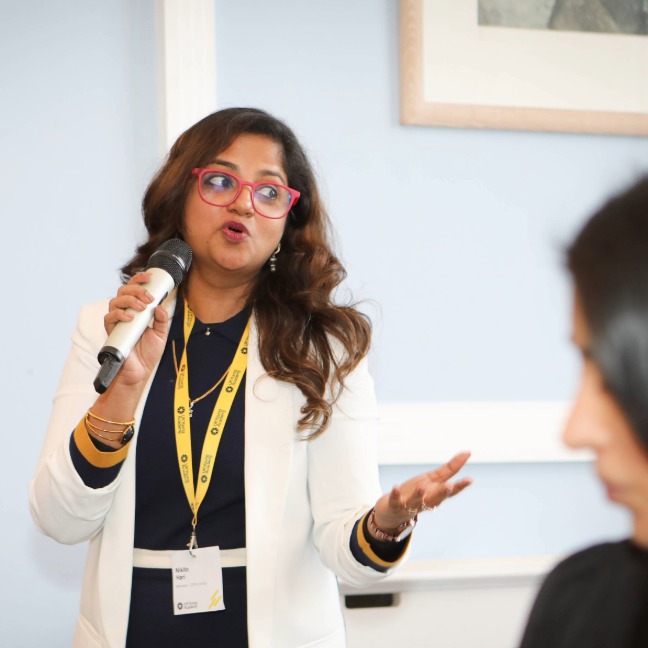
Following her recent appearance on the UK Young Academy podcast, Nikita Hari reflects on navigating an interdisciplinary career, why you don’t need permission to start shaping change, and why belonging matters just as much as ambition.
As a child, I used to line up my teddy bears and teach them.
I didn’t know then that I would become an educator or that engineering would be my language, or I would move between research labs, lecture halls, startups, policy conversations, and educational reform. I only knew that I was fascinated by how things worked, not just the physics of systems, but the people within them.
My dual curiosity in engineering and humanity didn’t always feel welcome.
For a long time, this intersection felt like an anomaly of sorts. Growing up in an environment where hard sciences were prized, there wasn’t a language for someone who loved both equations and empathy. I often felt like I had to choose: be technical or be human. Be rigorous or be relational.
When I entered academia and industry, that tension followed me.
I moved between worlds: Research and Development (R&D), teaching, entrepreneurship, policy. I built companies. I pursued research. I designed curricula.
Struggling to describe who I was professionally led me to question whether the system was the problem or whether I was. There is a subtle pressure in professional life to stay in your lane. Forced to wait until you have the title. And then wait until you are senior enough. Importantly, to keep waiting until someone validates the direction you’re already walking.
And when you don’t see people like you, who are fluid, interdisciplinary, intersectional, and unwilling to be siloed, it can feel heavy and lonely.
One of the most powerful lessons I have learned is this: You do not need permission to start shaping change — but believing that is not always easy.
When we began our Science and Technology Diplomacy project work, diplomacy felt distant, reserved for those “in ties and suits and sometimes, heels too,” in formal rooms with visible authority and true positional power. It seemed like a world you entered only after decades of credentials.
Yet the challenges we face — AI ethics, climate technology, health equity — are shaped long before those formal negotiations. They are shaped in classrooms, laboratories, communities and conversations. Importantly, in conversations between disciplines that rarely speak to each other.
Our project team soon realised diplomacy is not a building. It is a practice.
And that realisation required something deeper than ambition.
It required courage. The courage to begin before being invited. The courage to risk being seen as naïve. The courage to step forward without guaranteed recognition.
But the part we don’t speak about enough about is while you do not need permission, you do need belonging.
Before becoming part of the UK Young Academy, working across boundaries could feel isolating. When you move between academia and industry, between engineering and policy, between technical systems and social systems, it can feel like cycling uphill without seeing the end point.
Then suddenly, I wasn’t cycling alone. I was on a bus with a tribe, surrounded by others who understood the value of crossing boundaries. Engineers collaborating with artists. Social scientists challenging technologists.
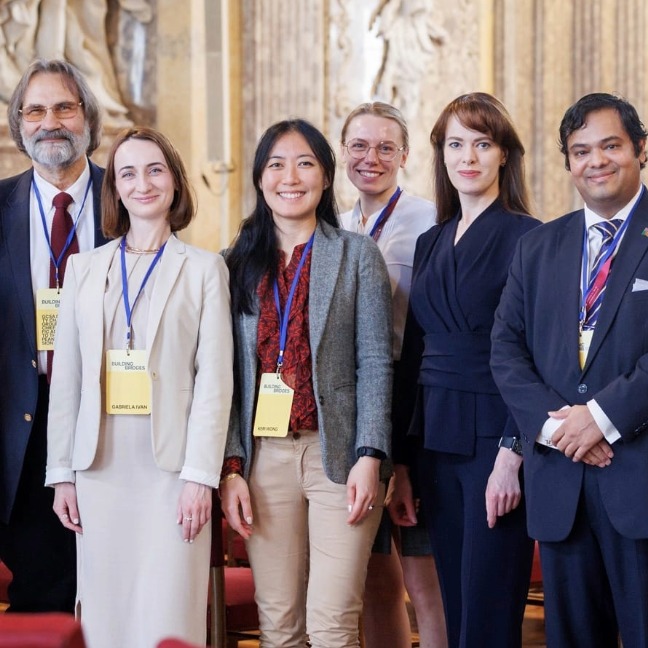
The UK Young Academy became that space for me where early- and mid-career voices are not drowned out but amplified. Where interdisciplinarity is not treated as an identity crisis, but as a strength. Where engineers, artists, policymakers and scientists sit at the same table and co-create.
The UK Young Academy gave me something I hadn’t realised I was missing: validation without conformity. Credibility without rigidity. Community without sameness. It reframed what I once saw as a belonging battle into a strength, and it reminded me that interdisciplinary work is not confusion; it is connection. That fluidity is not weakness; it is adaptability.
And that being too broad can actually mean being integrative and systems thinking.
In this space, I learned something profound:
- Authority is not the same as impact.
- Titles are not the same as influence.
- Nothing small is insignificant.
A conversation can spark a collaboration, collaboration can build a movement, and a movement can reshape systems. Indeed, the hardest step is often the first one, where you are deciding you are allowed to take it.
Looking back, I realise that I was never lacking capability. I was lacking a room built for people like me, and when you find or help build that room, something shifts: your voice steadies, your doubt softens, and your courage expands in leaps and bounds.
If you are early in your career, working across disciplines, or questioning whether your path fits, please know this: You do not need to wait until you are fully formed, you do not need to shrink to belong, and you do not need permission to begin. Start shaping the change you want to see. And if you can, find or create a community like the UK Young Academy where collective purpose meets courageous experimentation, you’ll discover something even more powerful:
Because when we connect ideas, people and purpose, change doesn’t wait quietly for permission. It dares to accelerate with courage, confidence, and conviction.
Learn more about Nikita and connect:
Author
Head, Teaching, Research Design and Support Group, Engineering Science
University of Oxford