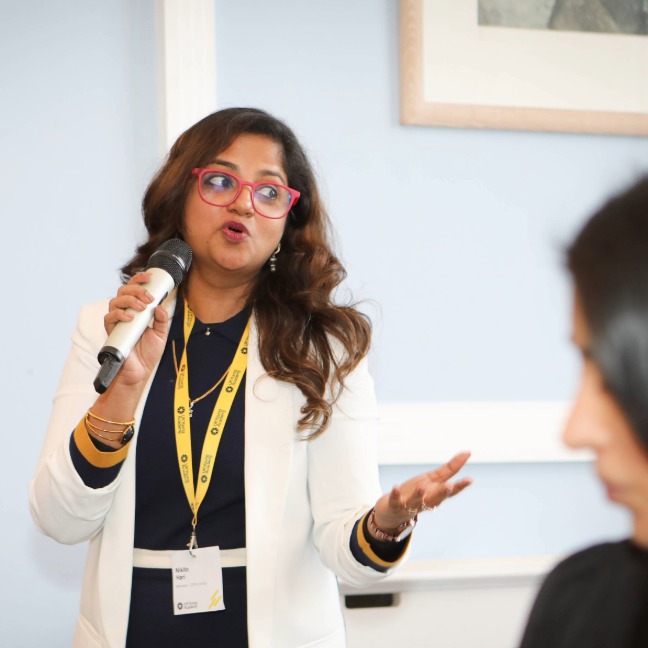
Discovering the world of science diplomacy: a new academic identity?
My key lessons from operating at the intersection of government and academia: No matter what academic discipline, we should shift away from thinking that there is just a single career path in academia or pathway to impact, but rather consider it a flexible journey where we are afforded the freedom to incorporate creative new ways to make a positive impact.
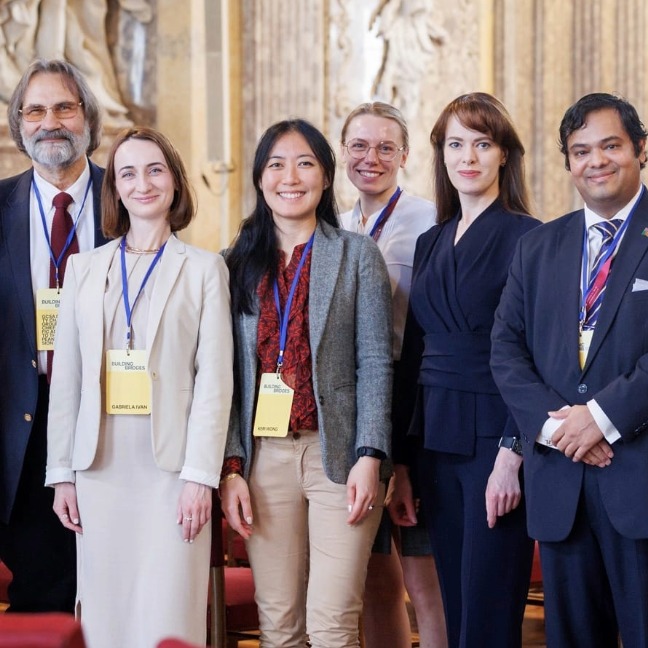
I’ve been asked many times: ‘What is joining the UK Young Academy like?’ My response: It feels like standing at a crossroads where every path is sunlit and inviting — no wrong turns, just different adventures.
How I got here
In May 2025, just 6 weeks into my membership, I represented UK Young Academy at two international conferences as an early- and mid-career researcher (EMCR) who was just curious about translating academic evidence into policy.
Speaking at the Scientific Advice Mechanism (SAM) in Vienna on a panel organised by the International Science Council and the European National Young Academies (ENYA) conference in Bern connected me with other European young academies that I didn’t know existed. From the Swiss Young Academy to the Global Young Academy and the Austrian Academy of Sciences: the room buzzed with passionate individuals all keen to share, collaborate, and facilitate ‘science diplomacy’ in Europe.
Here I was introduced to the world of ‘science diplomacy’, ‘science 4 policy’, and ‘science and policy,’ (terms all foreign and new to me at the time), and where my horizons broadened beyond the UK context to the EU level.
The conversations I had fundamentally shifted my identity as a scientist and challenged the meaning of being an academic in London.
My renewed sense of purpose culminated when in conversation on the only EMCR panel: I listened and shared my experience and reflections as an Economic and Social Research Council Policy Fellow, my research on the importance of ‘social trust’, and my passion for EMCR development with other representatives in the room.
Those few days proved invaluable (see my detailed reflection of the SAM and ENYA conferences, respectively) and I have since returned to share with my UK Young Academy community and academic circles.
UK Young Academy podcast and diving deeper
In Season 1 Episode 1 of the UK Young Academy podcast, I share my experience of being thrown into the deep end just 6 weeks into joining this community, reflecting on the opportunities offered, how this complements my ever-evolving academic identity, and what it means to pay it forward.
This blog takes that reflection further, exploring my first-hand experience operating at the intersection of government and academia through a few key ideas:
- the importance of higher education and being an academic in today’s turbulent world,
- our willingness to accept diversity in the academic career path and where knowledge brokering fits in,
- the need to rethink current systems and structures to promote knowledge transfer between academia, government, and policymaking.
Lesson 1: the importance of being a (real) academic
What we all share is human connection. Connecting on a human-to-human level is vital in any line of work, so being an academic eager to share evidence with policymakers is no different.
As an academic, I’ve often been trained to become increasingly specialised and an expert in my field. But at the policy/academia intersection, it’s key to step back and listen first — to understand what the other party wants and the challenges they face, before responding with clarification and/or potential solution(s). This process of understanding one another without judgment builds trust, levels expectations and identifies shared interests, which are essential for any partnership.
On many occasions I’ve found it incredibly helpful to broaden my perspective. I love being challenged by individuals from different parts of society and disciplines because this kind of discourse, though rare, encourages and pushes my thinking and vision in unexpected ways. Disagreeing well is a mindset that makes space for new ideas, opportunities, and room for growth. Often, I gain alternative contexts for what I’m trying to do in my main research.
The multi-discipline/sector community of the UK Young Academy provides one such ecosystem. As we look to the future of an ever-changing world, knowledge transfer across disciplines, sectors, and cultures will become increasingly important in problem solving. As such, we must leverage our ability to connect with one another through our shared values as the ‘experiential change’ that happens within each of us will, arguably, be irreplaceable by AI advances.
Lesson 2: diversity in an academic career and identity – becoming a knowledge broker
As an early- and mid-career academic, doing anything other than your research may raise an eyebrow from your academic peers. Whilst there are very real opportunity costs to engaging with the media, podcasting, knowledge exchange work, and writing blogs (i.e., time spent away from research doesn’t add to your academic currency), there are long-lasting upsides to these opportunities.
Both personally and professionally, I have come to appreciate much more how transferable these skills and insights are and can see the value-add to my academic role, be it my research, teaching, or involvement with the UK Young Academy community.
Crucially, the opportunity earlier this year to meet with other young academies in Europe, leaders of the EU Commission, and the International Science Council reminded me of what it really means to be a scientist:
- to uphold the truth,
- to operationalise the scientific process in generating sound evidence to counter misinformation in government, media, and policymaking,
- and to recognise that, whilst public trust in science remains intact, translating science to the public is where we need much work.
For other interesting publications that speak to these ideas, make sure to read the Royal Society’s Science 2040 Report and the British Academy’s Public Trust in science-for-policymaking report.
Furthermore, my UK Research and Innovation policy secondment to the Home Office and the Royal Society Pairing Scheme has shifted my identity, giving me a better understanding of the patience required for policy realisation.
Given that my own research examines the causes and prevention strategies around crime (think Labour’s Safer Streets Mission and Young Futures Hub), my original frustrations with government inaction narrowly focused on my academic expertise rather than engaging with the reality of developing a policy portfolio.
And of course, my attendance at the SAM and ENYA conferences led me to join the International Working Group and Science Diplomacy Project team. Further participation in UK Young Academy activities is perhaps the most humbling: to be a part of a multidisciplinary community of ambitious early-career professionals who – like me – are readily willing to lend their expertise to up-skill each other on topics ranging from AI, neurodiversity, and climate action, to name a few.
As a Young Academy, we’ve also benefitted from the support of our seven senior partner academies with bespoke training and opportunities extended to us, that allow us to feed into important conversations and engage in key matters for societal good—such as the UK’s provision for at-risk scholars and professionals, and responses to rise in visa fees.
Lesson 3: rethinking systems to promote academic and government/policymaking working
Against all the amazing experiences I’ve had, the question I’ve asked often is: ‘How can more academics benefit from what I’ve experienced?’
Clearly, the current academic career path lacks training in government and policy engagement, yet the ECR progression to senior roles often demands such engagement. So how can we rethink current systems to ensure interactions with government and policymakers are more streamlined?
As I progress through my career, I’ve had more and more exposure to the government/policy world, so here are my suggestions:
First, if you are meeting with government or policymakers, invite an ECR.
As part of the Royal Society Pairing Scheme, I had the pleasure of hosting Baroness Pauline-Neville Jones on several occasions to shadow my work with youth clubs on the Safer Streets Mission, my Home Office secondment, but most importantly, at University College London (UCL) where she got to hear from and meet my lab group and key stakeholders I work with at the UCL Centre for Education and Criminal Justice.
Students and stakeholders got to present their research and key issue to the Baroness and received constructive feedback on how the pitch could be better tailored to Parliament, the House of Lords inquiry, and the ways forward to bring about policy action.
For example, our finding that youth clubs provide young people with a ‘safe space’ that also deters them from crime is what we want policymakers and the public to understand.
Second, funders and universities should facilitate cross-sector knowledge engagement activities that give ECRs a platform to engage.
As part of my UK Research and Innovation (UKRI) Policy Fellowship I co-produced a conference with the Home Office Analysis and Insights Team. Being the first collaboration between the Home Office, UCL and UKRI, I co-created a bespoke program of talks to address current policy priorities in the ‘UCL – UKRI Connecting the Dots Conference’. Colleagues were able to expand their access to research experts, hold constructive exchanges in a safe environment, and give ECRs (masters, PhDs, Postdocs) the exposure to connect with government policy and analytical teams.
Again, this was a huge success that led to new collaborations and connections across sectors and individuals’ career stages.
Third and final suggestion, help correct misinformation and destigmatise the stereotypes of academia. Whilst stereotypes can work for or against a sector, the stereotypical academic who perhaps struggles to communicate effectively and accessibly to the public is one that people in other sectors often hold.
In response to this, I’ve shared a helpful infographic on ‘Government tips for work with Academics’ (Wong, 2025) to help government civil servants demystify the reasons why they should engage with academics. It’s free to download and use, so please share!
Ever wondered what else academia can be?
If you’re interested in life outside academia or how to expand your portfolio of experiences to include a policy-relevance angle to your research, here are a few schemes that have shaped my journey and thinking over the past 24 months.
- UKRI Policy Fellow (2023-25) – 18-month secondment to the Home Office
- Royal Society Pairing Scheme (2025) – once a year; 30 scientists paired with 30 parliamentarians of ministers
- DSIT Fellow Expert Exchange Program (2025-26) – 12-month secondment to the Department for Science, Innovation, and Technology (DSIT) on the ‘Future of Childhood and Adolescence’
Learn more about Keri and connect:
Author
Associate Professor of Developmental Psychology, Co-Director UCL Centre for Education and Criminal Justice
University College London