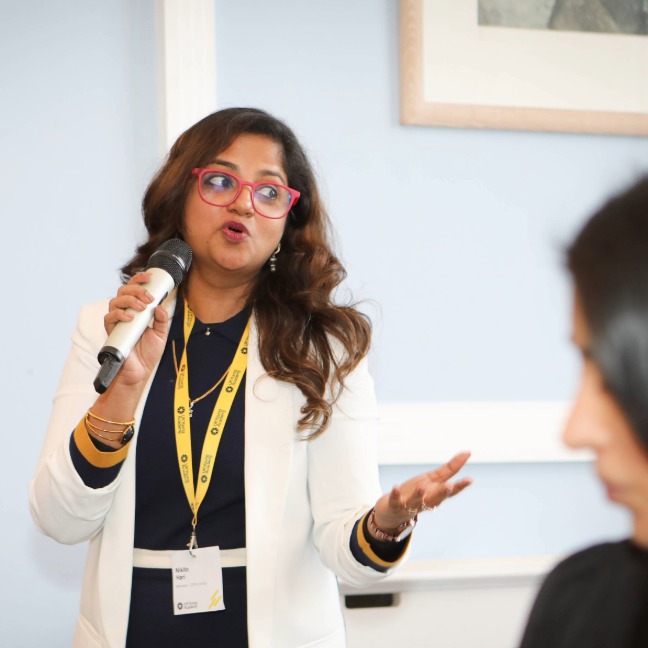
Nikita Hari on embracing failure and taking risks
UK Young Academy podcast | Season 1 | Episode 4
Join the leaders of tomorrow on the UK Young Academy podcast. Hear from members working across disciplines and sectors as they share their journeys, the highs and lows of their careers, and what drives them to make a difference.
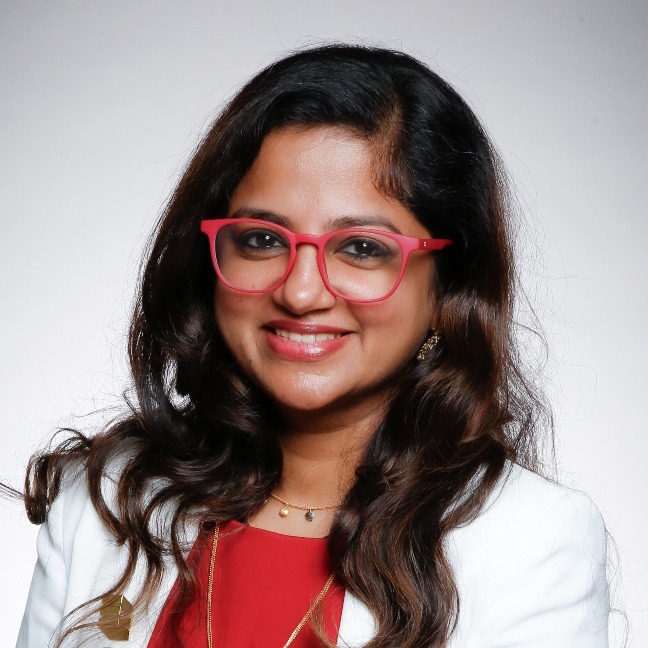
On the fourth episode of the UK Young Academy podcast, Nikita Hari, an electronics engineer and educator, shares her journey from academia to industry, emphasising the importance of interdisciplinary work and the role of the UK Young Academy in fostering collaboration.
She discusses her work in engineering education, her involvement in tech start-ups, and her contributions to science and technology diplomacy. Nikita also offers advice to young professionals, highlighting the value of embracing failure and taking risks.
You can listen to the UK Young Academy podcast on all major streaming platforms, including:
Learn more about Nikita and connect:
Transcript
Please note that these transcripts have been automatically generated and may feature errors.
Wenmiao Yu (01:06)
Today on the UKYA podcast, have another of our members, Nikita. Nikita, would you like to introduce yourself and a bit about what you do?
Nikita (01:15)
Hello everyone. It’s a delight to be hosted by the UKYA. I am Nikita Hari. I am an electronics engineer and researcher by training, educator and entrepreneur by practice. And I’m currently leading the practical engineering education at the Department of Engineering, University of Oxford. I have worked across academia and industry designing next generation power systems.
As a researcher, creating products, as a co-founder of tech startups, advising on policy, working with charities and governments, and currently leading on a systems approach to higher education, whilst also mentoring and supporting many young people to engineer a better world through my association with the Queen-Elizabeth Prize in Engineering.
Engineering Professors council where I co-chair the complex systems project. So I would say my work sits at the intersection of education, enterprise and research, impacting pedagogy, policy and practice through influencing people, products and processes. And if you want to dig a bit more into how I ended up doing this, I’m happy to to elaborate.
Wenmiao Yu (02:35)
Let’s dive in then. So Nikita, how did your career start?
Nikita (02:40)
I would say as a kid, I was always and have been someone who loved how things work, both the physics and social sciences of why people behave in a certain way and so on and so forth. And I was kind of an anomaly of sorts because as much as you love doing physics or understanding ⁓ how and why your systems work, there was not much appreciation for the people involved, ⁓ especially coming from a country like India, where there’s a lot of emphasis on hard sciences. So I didn’t quite know what to do with my intersectional interest in both the STEM and humanities or arts and sciences, as you call it. And I’ve always loved teaching. So electronics engineering came as an obvious choice because I was bred and brought up in a manufacturing business household, making electrical switches. So after my undergraduate, I went straight into R&D (Research and Development). That experience, I think, led me to understand or know a bit more of myself. decided to do a master’s in power electronics. And that is where I discovered my acumen in research or how much I enjoyed that.
To also formally start teaching. And to my surprise, I loved that interdisciplinary world. So after that, I started off working formally as a lecturer at the National Institute of Technology, moving on to the Indian Institute of Technology as a research associate. And thereafter, I went back to industry, ran my own engineering firm and decided I wanted to bring the both of the worlds into my work
And that’s when I came to the UK to University of Cambridge to pursue my PhD. So balancing these two worlds of academia and industry, I think made me realise how powerful active applied education can be and should be. And I suppose that’s what motivated my PhD in applying machine learning for power electronics at Cambridge. And alongside
My research, co-founded two edtech startups and developed a practical hands-on engineering curricula and courses. And I suppose, you know, my own background and being a minority or being underrepresented voice in the engineering and STEM sector also encouraged me to do outreach to think about contributing or paying it backward or forward, however you want to call it and that’s how I started, understanding the importance of policy and how it has an impact, not just in the classroom, but across the world, across the societies and systems. And that led me to make the decision that I do not want to be in a traditional academic space – a Faculty for Future Postdoctoral Fellowship followed. I joined Oxford with that. And I would say that gave me the freedom to think about what it is that I want to do. And this neatly ties into, I think, my own interest in UKYA because work and careers and professions were very siloed. There was no respect or no acknowledgement of interdisciplinarity or intersectionality then.
So 15 years ago, I would say that was why I was not very sure or I couldn’t define my own identity or what, you if you asked me then about what I wanted to do. And I think all this brought together the space to kind of experiment. And it was then that Dyson and the UK decided to reinvent the education and research bill. So I joined Dyson Institute as a leader in innovation and enterprise. And I would say that launched me into the engineering education innovation space where all those intersectionalities can be beautifully blended. And that led to my work with the UCL Center for Engineering Education and my current role coming back to Oxford as a head of teaching and research design support group.
And I would neatly summarising my journey, I’d say with my current role, I fused that technical expertise, the teaching acumen and leadership skills to run the practical engineering education for the department. And I guess that’s where the thread, you see ⁓ the journey coming full circle as a kid who loved teaching teddy bears but not actually forging a career in that.
Alistair McConnell (07:16)
Thank you
Nikita (07:17)
Jumping through the worlds of academia and industry. And that allows me to shape the educational innovation. So it’s about, thinking creatively, solving real world problems and understanding the complex systems that we are all part of.
Wenmiao Yu (07:34)
That’s great. Thank you, Nikita. If you are speaking to someone still doing their undergraduate in the sciences now, and they wanted to work in a similar field as what you’re doing now, what is one piece of advice that you would give them?
Nikita (07:49)
I would advise students to make the best of every opportunity, platform that comes their way. And I would very strongly encourage or recommend people to take risks, right? You study best when you study through failures. Failure is always the best lesson but I think we have all become very risk averse. You want to know exactly where you want to be. So I would say, very much be for that approach to life or career or profession where you appreciate the journey and not the destination. know, like you have to learn through different experiments and you have to learn it by doing and put yourself out there. Grab every opportunity that comes your way, right? So that’s what I would say. Like do not take life too seriously that you are constantly fearing of failure and to see it not as failure but to reframe it as another learning opportunity.
So embrace failure and explore the world of opportunities is what I would advise if it was a one-liner.
Wenmiao Yu (09:00)
Thank you.
Alistair McConnell (09:02)
So you’ve really gone through a lot of your work, how you got into it. And it’s fascinating to hear exactly what your drive was. And the whole aspect of having learning points instead of failures is really a great thing to hear. Could you actually tell us about some of the work you’ve been doing with the UK Young Academy?
Nikita (09:24)
Thank you. ⁓ So I suppose, you know, drawing on my own interest and ⁓ I’ve always seen UKYA as that unique and rare space where early to mid-career, very young voices can find and create our own identities, space and do meaningful work through collective action. And that’s how I see UKYA. Now, what am I doing or how am I contributing to this space? I’d like to shed a bit more light on the science and technology diplomacy project that I co-lead. So whether it’s AI ethics, climate tech, or health equity, we can agree that diplomacy is at the heart of today’s global challenges, particularly in the polarised climate we are all grappling with. To make things worse, early to mid-career voices are often missing from these big conversations. And that’s where our project, Science and Tech Diplomacy in a Changing World comes in. So led by Sandeep, Claire, Jennifer and Alice, alongside myself, we see this as an opportunity to help build skills, create opportunities and grow a network of future leaders from the UKYA who are ready to influence international collaboration, be it from climate negotiation to digital diplomacy. So as much as it is about education around diplomacy. It would also be about creating a shared language or vocabulary for engagement, focusing on capacity building. So giving people the tools, the networks and a platform for bringing the ideas or bringing their voice to the diplomacy world, which generally looks down upon younger voices. And a launch event ⁓ at the British Academy brought together scientists, engineers, policymakers, and non-state actors. And I think it clearly showed us that diplomacy is not just about embassies. And I think that’s our point. It is co-created in classrooms, in cities, and communities. So we really want Young Academy members to be able to come together and be part of the big and bold conversations happening around us.
Alistair McConnell (12:04)
I would say, mean, that Science and Tech Diplomacy project is absolutely fascinating and definitely, as you said, essential in this current climate. And you’re really, I mean, justifiably proud of that project. And I would be, I would be as well. I wish I was on that one, but I look forward to reading everything that’s coming out of it. But as well as all the successes, sometimes we do face some challenges. like what challenges have you faced along the way and how did you actually overcome those? Maybe in the UKYA or even just of your career journey.
Nikita (12:35)
Obviously, I think the biggest challenge of working in an interdisciplinary or an intersectional field is there is always an identity crisis, maybe much less than before. I think we are currently in the right place and time where organisations such as UKYA exist to give credibility and to amplify our voices.
Finding my own voice drowned in the noise of the world, amongst the different careers and the different opinions and perspectives around it was personally a very difficult challenge to begin with. But navigating that space and now when you look at allowing, giving myself the freedom to believe in what I’m doing and my interest and also constantly I think relearning, reinventing, so skilling, upskilling and believing that your skills are all going to matter at some point, right? So doing what you believe in was probably the most important thing that got me to where I am currently, but the challenge was, think, constantly needing to fight those battles because, know, when there is no… acceptance and acknowledgement. And when you’re doing something which is not within the normal it is always a difficulty. And coming now to the UKYA, I think even if you look at the project or even if you look at other aspects, it’s often all this, you know, ⁓ it’s a unique and rare space like I’ve pointed out before and all this big and bold ideas. And often there are abstract conversations to make that into a tangible impact full initiative or project and doing that at scale, I would say is the biggest challenge. And I think that’s why in our own project, we’ve looked at it from, because diplomacy is a ⁓ very chaotic, especially currently, and a diverse world. So what exactly is that we want to do? So to decide your first step and to think about the impact of it and how are you gonna measure the impact of it and going through that process and of that was I think the most challenging. mean, once you figure out the first step, then it’s fine. Things fall in place, people come together and things fall in place. But the beauty of it, I think is definitely the people, right? Obviously people are the heart of every system.
And UKYA is no exception, but I think it’s a very eclectic mix of people here. And I think that’s what the diversity of thoughts and perspectives. And to be able to be in a space which respects those differences and to agree to disagree, I think it’s quite important in today’s world as well.
Alistair McConnell (15:34)
That’s great definitely an eclectic mix we have within the UKYA and that is, as you said, one of the most fantastic things about it is really that diverse range of views and the slight chaos that sometimes goes with it as well. You have actually touched on this, but I’m just going say how has your involvement with the UK Young Academy shaped your actual work or your perspective on things?
Nikita (15:57)
So like I said, ⁓ being in the UKYA ⁓ has made me ⁓ feel part of a tribe, even though we all, ⁓ at some point or the other, I don’t want to encourage tribalism in the negative manner, but you know what I mean, right? We all want to be part of a community. And I think UKYA gave me that community because suddenly I realised I’m not a lone voice because that can quite be the case when you are in a very big university and you don’t have a siloed approach to work and life. And that can be very disheartening and it’s a lonely journey. And I think I suddenly felt part of, you know, it’s like when you’re on a cycle, not seeing the end point and suddenly, you know, you are in a bus, right, with people who you can talk to and who share your vision of the world and who are aspirational. So I suppose ⁓ the feeling of being together has been one of the most emotionally gratifying aspect of being in UKYA. And obviously that has made me more aware of the power of interdisciplinary and collaborative work and how much, how… much of impactful work can be done or achieved when you give people the freedom, the right place to co-create without rigid boundaries or without recognition. I would say it’s given me more confidence and more hope for the young people behind me that there are always going to be spaces and platforms such as the UKYA a shared purpose and you are able to convert your passion into a meaningful action ⁓ or initiative and you have people together while you’re doing that. So I think that’s my biggest, you know, I do like, I would like to segregate that into my technical and my emotional or moral benefits of being in the UKYA.
Alistair McConnell (18:10)
That’s great. And it’s really good to hear that. And of course, a lot of us, we’re just kind of still setting the foundations in a way for hopefully all the generations to come through the UKYA. You did briefly say impact when you were just talking there. And a way, what do you hope your work, the impact of your work will have within the UK Young Academy community or kind of beyond that? I mean, you touched on it a little bit, but do you want to elaborate?
Nikita (18:36)
I from ⁓ a personal perspective, I’d love for, again, maybe I should roll back a bit and if I look at how I would describe my work in a line or something, I’d say I ⁓ inspire young people to engineer a better world. So if I draw on the same aspiration, I think I would see our work through the project or all the different initiatives of UKYA giving young voices the right space and credibility to embed interdisciplinary insights.
For myself, I would say as an engineer, right? I would like to see this as an opportunity to give that acknowledgement that engineering doesn’t happen in isolation. Engineering should, you know, be neatly working with humanities and the blend of all this is how decisions are made globally but there is not much of a acceptance of the fact. So personally, I would like to see more of engineers and social scientists and people from all different walks of life work together to solve global problems. And as this is a first step, see UKYA as being an initiative community which can educate people about the need to do collaborative work so that all these diplomatic or all the initiatives don’t have, you know, it’s like you’re talking about AI from technical terms and ethics is an afterthought because people think that AI is more of a hard science. So it should be ingrained into the design from the start. I think creating that intersectionality and interdisciplinary aspect into the design process right from the start, whatever it is, whatever it is that we are talking about from government policies to technical projects. And I think that’s where I see organisations such as UKYA leading the way.
Alistair McConnell (20:40)
That’s great. And just almost a final one on this section is you talked about challenges, you’ve learned, things you really hope the UKYA strives for. Are there actually any key lessons, like if you want to summarise or that you’ve maybe missed out, lessons that you’ve learned through your UK Young Academy involvement?
Nikita (21:02)
So the key lesson I would say is understanding or is the freedom to explore without actually taking permission, right? And this is probably a bit more generic statement I’m making. And what I have learned is that, okay, you don’t need permission to start shaping the change you want. Because when we were thinking about our project, okay, diplomacy seemed to be for those in ties and suits and heels in fancy, ⁓ rooms with authority, right, and power to initiate change. And that’s how we have seen diplomacy. And I think then to think about it as something at the grassroots that we can start shaping was what I have learned. And I think finding that power of authority and freedom to find the right people, place and just getting started, right? So I would say nothing small is insignificant is what I’ve learned. That would be a big lesson and that’s what I want to keep reminding myself.
Wenmiao Yu (22:13)
Nikita, I think a lot of what you said earlier really resonated with me as well about finding your tribe and finding a community of action-focused individuals in the UKYA. I think that was quite refreshing as well. So how can other members of the UK Young Academy help or support with your work?
Nikita (22:29)
So, yeah, I would say, you I would see UKYA, right, becoming that go-to network for very bold cross-sector projects and initiatives where ideas are tested ⁓ without the fear of failure and can be tested quickly and collaboration cross boundaries and disciplines and so on. So for our current, you know, we are planning the next phase of our work and taking it from conversation to education and action and building international partnerships across the UK and globally, we would encourage anybody from the UKYA who’s interested in just even understanding what diplomacy is or redefining diplomacy even and reinventing the space. Whether it’s learning or contributing, you’re more than welcome to reach out to us and join the team.
Wenmiao Yu (23:23)
That’s fantastic. Thanks for sharing a bit about some of the potentially exciting projects where you have under the belt at the moment. So for you personally, Nikita, where do you see yourself in say three years time?
Nikita (23:36)
Probably, with all the work that’s going on at Oxford, with the engineering education, with the new building projects, the future teaching, I think I would see myself having influenced or having designed and delivered projects that I’m currently leading or initiating. And in three years’ time, I think I would see the fruits of my action.
And as far as UKYA is concerned, think I would obviously be by the time, I think almost in the exit road of becoming a proud alumni, paying it forward and backward through mentorship and so on and so forth is how I imagine what I will be doing. But in… introspecting or reflecting back. would also say that three years down the line, I suppose higher education space is going through a turmoil and I would probably expect more stability in the space as well. So yeah, I’m quite looking forward to what the future awaits, but I don’t see anything dramatically different to what I would be doing. And I’m somebody who don’t plan for my next three years in the sense that there are so many things happening. So I think I am waiting for the culmination of all that and to see the impact that has had on people and projects and policies.
Wenmiao Yu (25:04)
Just picking up on a point that you mentioned earlier, what is one challenge in the higher education space that’s affecting you now that you would hope to have been resolved or to have passed over in three years time?
Nikita (25:17)
I think the biggest issue in the higher education space that we are currently dealing with, obviously there is the financing, there’s all the jobs being lost, there’s a lot of turmoil in the higher education sector, but there is also a rearrangement of the sector frameworks, processes and systems. It’s a heavily complicated, a complex system and there are complicated processes. So I would see, I would… hope that the higher education sector would be more embracing of individuals such as myself or professionals with fluidity of agency who can work across sectors and bridging professional services or academic environments. So I think in three to five years time, I would see a dramatic shift in how rewards and recognition in how ⁓ retention in how ⁓ not just for students, but also for professionals in the sector, right, are currently dealing with. So I think as much as I like to be hopeful, I would say the higher education sector would need to be more collaborative than it ever has been. And it cannot work in siloed manners. So I expect more integration, embracing intersectionality and interdisciplinarity in the few years to come.
Wenmiao Yu (26:48)
Thank you. Now Nikita we’re entering into the quickfire questions I’m going to ask you three questions and hope that you’ll be able to respond with the first thing that comes into your mind. So the first question is, what is the best piece of advice that you’ve received?
Nikita (27:03)
Say yes to opportunities even if you think you’re not quite ready and you will grow into them.
Wenmiao Yu (27:10)
What is one thing that you personally cannot work without?
Nikita (27:14)
A notebook, whether digital or otherwise. think I am very much a, you know, I have to sketch, I have to write, I have to strike. Yeah, so all my creativity and my stress or whatever it is has to be conveyed, I think, through that, whether it is writing or drawing or whatever.
Wenmiao Yu (27:39)
Interesting. A lot of engineers, I know, also have that trait. And final question, what is a book, podcast or resource that you would recommend?
Nikita (27:48)
Since we have talked a lot about intersectionality, interdisciplinarity, the higher education sector and somebody who is in the space, I would strongly recommend a book called The Impact of Integrated Practitioner in Higher Education. And so it’s a narrative, it’s case studies of people working in the sector who have led the world, who have led the change when… you know, everybody else were working in silos. So it’s about third space profession and professionalism. And that’s what I would recommend.
Wenmiao Yu (28:22)
Great, thank you Nikita.
Alistair McConnell (28:24)
So it’s been really great talking to you Nikita and I would just want to thank you again for taking the time out of by what sounds an incredibly busy and hectic schedule to talk to both of us. And obviously then to talk to everyone through this podcast. It’s been great to hear about everything that you do, everything you fit into the day. And I do have to say, I echo you. I always have some method of whether it’s a notebook, my phone, something I can write down notes, I can sketch out. 100% I agree with you on that one. I just want to ask if you’ve got any final thoughts or advice, and also where can people actually learn more about your work or connect with you?
Nikita (29:02)
So final thoughts, I think I’ve probably touched upon this many times, but it’s that change happens when we connect ideas, people and purpose, find collective meaning. And that’s what UKYA has given me and many of the likes of me a space to find our tribe, to connect across disciplines and make a real world impact.
Alistair McConnell (29:03)
That’s you very much for all of that. We will obviously make sure to have all these included with the podcast. And yeah, it’s been great listening to you, hearing everything. yeah, that’s us done ⁓ So until next time, thank you for listening.
Wenmiao Yu (29:21)
Thank you very much, Nikita.
Nikita (29:26)
So whether you’re an engineer, artist or a policymaker, your expertise matters in shaping the future. And you are welcome to connect with me on LinkedIn and you can follow our UKYA projects through the UKYA Academy website and socials as well.
So thank you very much once again for having me here.
Author
Lead Author
Head, Teaching and Research Design Support Group, Engineering Science
University of Oxford

Supporting Authors
Wenmiao Yu
Co-Founder & Director of Business Development
Quantum Dice Ltd

Alistair McConnell
Assistant Professor in Computer Science
Heriot-Watt University