Building diverse communities with Denis Newman-Griffis
UK Young Academy podcast | Season 1 | Episode 3
Join the leaders of tomorrow on the UK Young Academy podcast. Hear from members working across disciplines and sectors as they share their journeys, the highs and lows of their careers, and what drives them to make a difference.
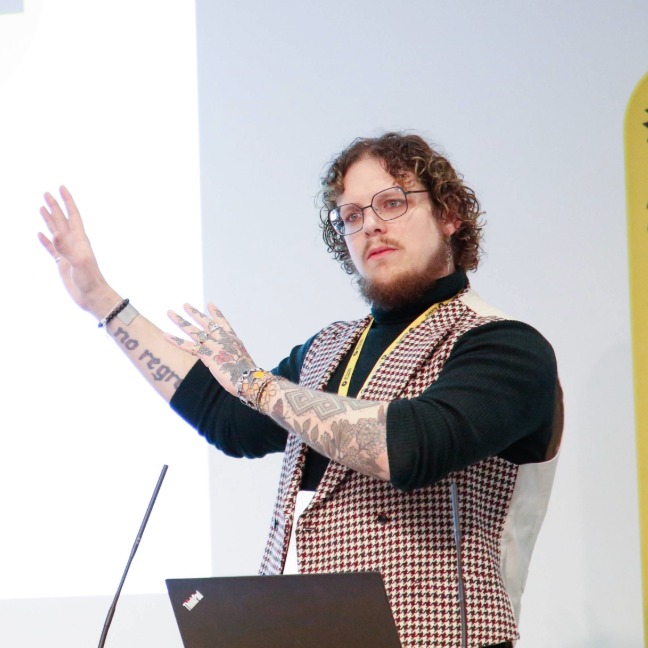
On the third episode of the UK Young Academy podcast, Denis Newman-Griffis shares their journey from computer science to leading AI and health initiatives at the University of Sheffield. They discuss the importance of interdisciplinary collaboration, challenges faced in academia, and their motivations for joining the UK Young Academy.
Denis highlights their contributions to the Young Academy, the impact of this work on their professional life, and their aspirations for the future of the organisation. They emphasise the need for continuous improvement and the importance of building a supportive community.
Learn more about Denis and connect:
Transcript
Please note that these transcripts have been automatically generated and may feature errors.
Wenmiao Yu (01:06)
Today on the UKYA podcast, Denis, it’s a pleasure to have you. Could you tell us a bit more about what you do?
Denis Newman-Griffis (01:13)
Absolutely, thank you. It’s a pleasure to be here and very glad that this effort is happening. So, yeah, I’m Denis Newman Griffiths. I am a senior lecturer at the University of Sheffield in the School of Computer Science, and I’m part of a leadership team for our Center for Machine Intelligence at the University of Sheffield. So I lead on AI and health work within the center. So that’s my sort of day job within the UK Young Academy. I have a couple of roles as well. So I’m a member of the executive group and I’m one of the first co-chairs of the executive group.
Wenmiao Yu (01:42)
Fantastic. So with regards to the work that you do for your university, how did you get to that stage?
Denis Newman-Griffis (01:47)
So it’s been a bit of a long and circuitous journey. So I trained in computer science. I did my PhD in computer science and engineering and started out working in natural language processing research. So sort of core what is now very popular AI technologies. Wasn’t so popular then. I ended up through learning about some interesting projects and looking for some funding, ended up starting to work in the health space and started to work, ended up working with a US government collaboration looking at natural language processing technologies in the context of disability benefits. So looking at like government benefits schemes, how NLP technologies, how the use of AI could help improve the sort of process of going through those schemes. And so that opens up this whole different sort of area for me to be working in and after doing my PhD,
I went and did a postdoc in medical informatics. I was really sort of moving primarily over into that medical sphere. And while working in that space and sort of starting to grow the things that I did, you know, I was working in AI and disability and there are lots of important questions about ethics and inclusion and, you know, what it means to have ethical AI, what it means to do inclusive development of AI when you’re thinking about, you know, when you’re thinking about disability.
And so that opened up the sphere of work that I was doing yet again. So now I was sort of sitting in a health informatics space, but starting to do work that was a little bit more critical methodologies, a little bit more social sciences of how we’re going about developing health AI technologies. So coming out of that, then I ended up, I was able to get a post as a lecturer at the University of Sheffield in the Information School. So I wanted to… sort of wanted to move to the UK, was able to find this post at Sheffield in the Information School. And the Information School was an interesting and appealing place to me because it was this sort of space for interdisciplinary working and asking questions about AI and data science in a more social science kind of way. And so next shift was moving over into a social science environment and starting to ask really, really much more deeply these sorts of critical questions and social questions about how we produce data, how we understand it, how we work with it in a responsible and ethical way.
In that role, then I was able to lead a couple of different research projects, looking at sorts of responsible practices around the use of AI and starting to bring that back into the work that I was doing previously in the health space. So then an opportunity came up, having sort of made this shift from computer science to the health informatics to social sciences, an opportunity came up to apply for this role that I have now as the AI and health lead for our new Center for Machine Intelligence.
And the CMI was intended to be a sort of interdisciplinary space, cross-cutting asking questions about AI at the university and helping to advocate for the work that we were doing. And this was something that was really appealing to me. And so I applied for it and said, AI and health is something where I’m really keen to help develop leadership. So I was successful in getting that job. And part of that involved then moving back into a school of computer science and sort of sitting within our faculty of engineering. So I’ve in some ways made the full circle, starting in computer science, ending up in computer science, but through this journey, through a number of different disciplines that I now bring to all of the work that I do. And part of why I was able to get this role actually, and part of what I really offer in it is that sort of interdisciplinary perspective of bringing together the way that a lot of different fields think and the way that a lot of different kinds of professionals think to really ask these questions about AI and health.
Wenmiao Yu (05:34)
I’m quite curious then because it sounds to me that the Institute is very interdisciplinary. What are some areas of friction that can come up when you bring researchers who are so specialised in different areas together?
Denis Newman-Griffis (05:46)
Yeah, well, there are, so I think there are areas of friction both in the kind of interpersonal and I guess research methods. the, well, the research methods is one part of it. So there’s some areas of friction that occur in how you do the work. There’s also areas of friction that occur at a more structural level in terms of how it’s supported within a university. So in terms of how you do the work, there’s actually really, really interesting challenges and often sort of
as a researcher will happen within your school, will happen within your walls. And it can actually be easier to collaborate with somebody who’s outside of the same organisation, because then it’s like somebody else’s problem, than it is to collaborate with people inside your organisation, but across different boundaries.
Wenmiao Yu (06:32)
I love that. It sounds to be, well, it’s very cross-cutting and actually quite similar, I guess, to what you have to do as a member of the UK Young Academy as well. So this leads me to the question, you know, I’m curious to understand what motivated you to first apply to be part of the UKYA.
Denis Newman-Griffis (06:48)
Yeah, I mean, I was really excited about it when I first saw that it was happening. So for me, one of the really key things that’s important to me in my professional life is to try to find ways to make a difference in the world, to make a positive impact and to
that in a way where I can help support other people, sort of help to make a difference that crosses between an academic sphere and the real world, you know, getting out of the ivory tower, to use the cliche, but also to help connect with other people who are trying to do interesting things, who are early in their careers, and who may be struggling with some of the same kinds of challenges that I’m struggling with. So seeing that this new thing, the UK Young Academy, was happening,
And that it was specifically being pitched as here’s a place for people who are early in their professional careers, whether they’re academics, whether they’re in the private sector, whether they’re in charities, what have you. This is a place to try to bring people who want to make a difference together to learn how we can work together and amplify the energy that we have, the ideas that we have, the skills that we have in trying to make a difference. That was enormously appealing to me.
And so that was really what I had in mind and where I wrote my application from. And I think I’ve found it to be a really core strength of being in the UKYA.
Alistair McConnell (08:11)
Now, it’s very interesting you’ve been mentioning, say, silos and walls around you. This is something that we find in academia, we find in industry, finding quite a lot of places. But really how you’ve touched on sort of breaking those down, which is a great thing. And interestingly, you obviously touched on actually having a cat earlier in a separate conversation. And I have heard sometimes getting academics in places is like herding cats.
Now, hopefully within UKYA, that isn’t the case. But could you actually tell us about some of the work you’ve been doing in the UK Young Academy?
Denis Newman-Griffis (08:47)
Yeah, so I think, I mean, every organisation has its hurting cats moments. And we are no exception to that. ⁓ But I’ve had the privilege to do a number of different kinds of things within the Young Academy. So I helped to found our EDI working group when we were first getting started. Start to put some initial policies in place around
you know, how do we build not just good principles of EDI into the work that we do as a UK as a young Academy, but also good structures that really can help deliver that. And so I helped with through leading that working group helped we helped design our leave policy, which was sort of a, you know, feels like a baseline minimum, you need to have this, but we didn’t have it. So we needed, you we needed to put it in place. And it’s been really wonderful to see that that
working group going off and doing fantastic things that are far beyond what I could have let it to do under the leadership of others. I have been, so I was elected as a member of our first executive group as the interim executive group back when we were first formed. And in that role helped to, I contributed to developing our strategy as a UK Young Academy, which was
really, really interesting process of working with our very diverse membership and very diverse priorities, very diverse ideas, and thinking about how do we distill the energy that we have, the passion that we have, the challenges that we want to tackle into a clearly articulated set of strategic priorities. That process was extremely well steered by Linda Oyama, and I’m very, very grateful to Linda for her overall leadership on that.
It was a really great chance to be involved in something like that. And I’ve certainly taken that experience into strategic planning and in other spheres outside the UKYA as well. And at the moment, I am chairing our ⁓ projects working group and have been able to work with our working group members, work with the feedback that we’ve been hearing as we have. Gotten our first sets of projects up and running, has been a really, really cool thing to see and a very fulfilling thing to see, coming from the initial ideas of we want to design projects, to now they’re happening and they’re making an impact and we’re seeing change as a result. I’ve been able to help lead through the working group ⁓ some updates to that process to sort of build in more opportunities for us to give constructive feedback and development stages to young Academy members who are putting projects together, thinking about how can we make sure that we are funding work that is best positioned to advance our goals as a young Academy, but also making sure that that funding process is a space for development, is a space for constructive feedback and helping to support one another. So I think working on that project process is perhaps the thing that I’m most proud of thinking at the moment, even if it hasn’t necessarily shown impact even internally yet, but knowing this is, you know, we have engaged in this member-driven process, we’ve engaged in this thinking about supporting what we want to achieve externally and how we want to develop internally. That feels like a good crystallisation of how I’ve really wanted to help serve in the UK Young Academy.
Alistair McConnell (12:05)
I would actually argue with you there that it has already shown impact because we’ve still had lots of projects coming in. There’s all of high standards. really showing that, for such a young organisation, what you’ve done, how you’ve pushed everything, and how we’re constantly improving, I think really is something to be proud of, as you said, and it does show that impact. If we’d had no projects, that would be a matter, but you’ve really encouraged more and more to come through. It would have made your decisions a bit easier then.
Denis Newman-Griffis (12:30)
Have a good day.
That’s true.
Alistair McConnell (12:35)
One thing I will say is you’ve mentioned there were some challenges as we’ve gone through. And like I said, we’re really quite a young sort of organisation. What challenges, I mean, maybe just one or two, or if there was one really major one, like have you actually faced and how did you overcome it or them depending on how many you find?
Denis Newman-Griffis (12:53)
Hmm. I think the biggest challenge actually is really an overarching one that has had many different forms, but it really is the same thing. And it ties to what you say about being a young organisation. we have, know, so as I mentioned, I’ve been a member of the executive group. also been one of the two co-chairs of the executive group along with Ed Pyzer-Knapp And so in that process of, or in that role, you know, our role has been to help steer the executive group and kind of chair meetings and set agendas and so on and so forth. And I think what that has given me is a lot of opportunities to see insight into the way that we’ve been shaping our work as a young academy, try to help advocate for ways to do it better, ways to bring in more and more input from more and more people within the young academy and externally. And I think the biggest overall challenge has just been recognising internally, engaging with our external stakeholders, engaging with all of our members, recognising the fact that we are young and we’re not going to do everything right on the first try. And realistically, we’re not going to do anything right on the first try. Because when you are an organisation that is doing what we have been doing, which is getting up and running and trying to move towards a process of business as usual and doing that, with a group of people who are absolutely fantastic, all of whom are volunteers. If they’re thinking about our membership here, and so we are supported by an absolutely incredible staff team and they are not volunteers and we are very glad of that. But there is that real process of iteration and of saying, you know, for everything that we’ve done, we’ve done this with the projects process, we’ve done it with our EDI policies, we’ve done it with things that we’re doing through our membership development in terms of training programs. It’s sort of we try to say, what do we want to be accomplishing? How can we get an initial version of something that can help us get there? And now what needs to be improved? What needs to be changed? Because we know it’s not going to be the right thing necessarily. It’s not going to solve the problem. So how do we then build in those structures, those processes and that culture of getting feedback, recognising this is something that will continuously improve that is a really important part of the challenge and it’s a really important part of getting the organisation running. And I think the fact that think we’ve been able to do that pretty successfully in building the Academy. But it is it is that challenge because we all care about this and we all want it to be working the right way and we want it to be, you know, uplifting the voices of all of our members to the most we possibly can.
Alistair McConnell (15:38)
We should always have a shout out to the staff team. They are fantastic and it is one of the only reasons we can do something like this. And so much, if not all of the UK Young Academy is because of our great staff team. just definitely shout out there.
Denis Newman-Griffis (15:52)
Absolutely.
Wenmiao Yu (15:53)
I echo that. Denis, while you were talking, I was actually thinking, you know, what you’ve done for the UKYA is actually maybe quite similar to what you have to do in your day job. Because again, I guess in your day job, it’s coordinating a lot of stakeholders who come from different backgrounds and have different experiences. And I wonder, you know, from your perspective, how do you feel about your involvement and all of the work that you’ve done in helping to set up the UK Young Academy?
How has that shaped your day job at the university?
Denis Newman-Griffis (16:25)
A lot of ways. For one thing, it’s given me lot more experience in how to chair a meeting, which is a very, very valuable skill that we don’t really learn when we’re coming up through academic training. And I think with that, the sort of skills of working with a lot of different stakeholders who maybe have different experiences. I think it’s one of the… real strengths that we have as a young academy is that we are not just academics. are industry professionals, we’re policy folks, we’re charity professionals, et cetera. And there are a lot of those challenges about like, we don’t all speak the same languages, we don’t all use the same processes. And so building this sort of space of how we can work together requires learning how to work across that. And that is something that, that is a skill that has really, really come in handy in my university role as well. And I think
With that.
So part of that is a kind of process skill, but part of it is also building a culture and trying to build a culture of recognising we have a lot of people doing a lot of really great things. We don’t want to control what people are doing, but we want to celebrate what people are doing and find ways to bring them together and find ways to say, we share these directions, we share these ideas. Let’s find ways to work as teams to articulate new kind of paths forward. And that’s, I think it’s a lot of what we’ve done in terms of the project’s process and the project’s development within the Young Academy. And it’s very much something that I’m now doing in my university role is, my remit is effectively to be part of this cross-faculty center within the university and to try to advocate for work going on at the University of Sheffield in AI for Health. And there are dozens of groups that are doing that kind of work. And I, you know, I haven’t hadn’t heard of many of them before I came in. And so my role now is really sort of doing a lot of that same work of saying, I want to come in and understand what all of you, like what everyone is doing. And I want to help see how can I, with the role that I have and the resources that I have, help to uplift what you’re doing and help to build new teams that can help achieve those goals and bring them further. So there are a lot of those kinds of skills about both how you bring people together, but then how you build that culture of we want to find shared goals, we want to celebrate what we’re doing, and we want to find ways of working together.
Wenmiao Yu (19:01)
I really like the emphasis that you put on building the culture. And I think from my perspective as a founder of the company, culture is always at the core of what we do. Although I have to say building a startup of a handful of people and building culture there is completely different to what I guess you and Alistair and other members have had to do off their leadership group in building that culture amongst such a large voluntary community. kudos to you guys for that. I also love that you shared and were able to take some of the lessons from your work within the UKYA towards your day job. I’m quite curious, to understand what impact in the longer term do you hope that your work either within the UKYA or in your day job will have on the communities that you are serving?
Denis Newman-Griffis (19:43)
Well, I very much hope that the UK Young Academy will continue to be and continue to grow as a place for people from very different backgrounds and very different professional experiences to come together and to find those shared goals, find those shared ways of working. That was what drew me in in the first place was the opportunity to do that. That was the biggest motivation for me in wanting to get involved with the leadership of the Young Academy. And so if we can… you know, if I can leave this leadership role, if I can eventually become an alum of the Young Academy and look back and see that it is still continuing to do that, it’s still continuing to grow and developing that reputation, that will be the best thing that I can possibly achieve. I think, you know, in terms of impact that I want to see in my work, that I want to see in the Young Academy. Something that’s really close to my heart is building better practices for working across disciplines and for working across sectors and professional settings. So I think it’s something that I have had lot of experience with and I’ve certainly run into a lot of challenges in. But I think that there is this growing understanding that most of the really big problems that we are facing in the world right now, whether we’re talking at a UK level, whether we’re talking at a local regional level, whether we’re talking globally, that those problems require tackling things that bridge disciplinary understandings, that bridge different sectors, that involve working together across different areas of expertise. And we don’t really have great ways of doing that. And I think we’ve been able to, within the Young Academy, we’re starting to develop a lot of that expertise. In my professional role, we’re sort of starting to build some of those things in, in the way that you know our center works and trying to build more of that into the culture of the University of Sheffield. So I think if I had a dream impact, the dream impact from what I do would really be to see interdisciplinarity and intersectoral are working moving from the sort of keyword we want to highlight this in the university discourse or professional discourse to we want to highlight it and we can build some structures to help support it and to help with kind of help people build the skills to achieve that and what they’re doing.
Wenmiao Yu (22:04)
I love that. Thanks for sharing.
Alistair McConnell (22:07)
So we’ve discussed quite a lot and we chatted quite a lot about what you’ve learned, what’s happened in the UK Young Academy, generally what’s happened in the past. Now, with other people I’ve said, where do you see yourself in the UK Young Academy in three years? However, I know for us that’s a of a trickier one, but I’m gonna say, so where do you actually see yourself in the UK Young Academy in the future, in a few years?
Denis Newman-Griffis (22:31)
I think… It’s a little hard to disentangle sort of where I want to see things and where in my various roles I’m kind of trying to push for achieving, you know, where we will be and where I do see things. It’s not that I don’t think that we won’t achieve our goals, but we all, you
Alistair McConnell (22:51)
We can split it. We can say where do you want to see yourself in a few years and then where do you want to see the UK Young Academy.
Denis Newman-Griffis (22:58)
Yeah, I mean, I think so in terms of where I want to see myself, so one of the areas that I’ve gotten really interested in over the last couple of years, partly from working in the Young Academy actually, is this really growing area of AI and science and AI and research. And so I’ve been able to lead a project that wrapped up recently that was looking at use of AI among research funders.
And it really opens up a lot of these questions about how do you get people working together? How do we think about AI as something that’s changing the ways that we work and changing the ways that we work with evidence and so on. I think where I see myself in a few years is I would really love to see myself in a leadership role, not necessarily a formal structured one, but like in a leadership position of bringing people together, bringing networks together around how we build good responsible practice and responsible regulation for AI and science. That’s something that I’m really, really keen to take forward. And certainly, think my experience in the Young Academy has been really helpful and effective preparation for that.
For where I see the Young Academy in a few years, certainly from a very mechanical standpoint, I really hope we’ve reached business as usual. And I think we will. But business as usual is never going to be usual for Young Academy because we are young. We will change. This organisation will continue to change with every new cohort that comes in. And that’s exactly what it should do. So there shouldn’t be any sort of staticness or stagnancy in the work of the Young Academy. I think where I would really like to see the Young Academy in a few years in the future is as a recognised key voice in the UK for helping to uplift and amplify the voices of early career people across sectors and as a leading example of how you can facilitate the kinds of dialogue between academics, industry professionals, policymakers, the charity sector, et cetera, that we need and that we are talking about in the industrial strategy. It’s in all kinds of things. To have us be, to have the Young Academy be this kind of beacon, this visible beacon with demonstrated work, demonstrated completed projects, demonstrated achievements that show here is how you can bring people across sectors together. And here’s a body of leaders who can help you do it.
That’s what I really want to see and I think we’re on the road to that.
Alistair McConnell (25:28)
That sounds fantastic. And yeah, I completely agree with you. I think we’re definitely on the road to achieving that. And seeing the leaps and bounds we’ve come in at the UKYA has been fantastic. Actually, how can other UK Young Academy members, I I hope all of us actually do agree with this, but how can the other UK Young Academy members engage or support your work? What’s the best way do you think for it?
Denis Newman-Griffis (25:53)
Well, think in terms of, break that down in a few ways, in terms of the sort of interdisciplinary working in general, it is my hope that through our project structure, we’ll be able to get something running through the work of the working group and potentially through a project to actually help develop some of that sense within the Young Academy. So keep an eye out, watch the space and see if there are things that come through for that.
In terms of the AI and science and other kinds of work that I do around responsible AI, if these are things that are of interest to you, please get in touch. I am always really interested in seeing how we can bridge different areas of interest, different areas of application and find new collaborations. the more, frankly, the more off the wall, the better. I just came back from a conference presenting was presenting an art-based research intervention where we had responsible AI hand soaps. So there’s a whole long story about that that I can tell, but it’s a good example of a little bit of out-of-the-box thinking.
And then I think, you know, in terms of the sort of broader work of trying to bridge these, trying to create more bridges between people in different sectors and people in different disciplines, it’s, you know, yes, talk to me, share things that you’re, you know, that you’re getting up to with me, let me help amplify the things that you do. But, you know, just keep on making those bridges yourself and remember that the more that you build, the more connections that you make, the more of a difference that that will make and it will continue to ripple out beyond you. you know, there are ways, certainly there are things that I am doing and I would love to chat with people about any of the things that I’ve talked about. I also do a bunch of work on AI and disability, which I talked a little bit about briefly. So if you want to chat with me about that, please do. But, you know, I would advocate for thinking more broadly of just go out there and push against the kinds of silos that we’re always surrounded by. Push against the boundaries in your organisation and talk to the people who you think might be able to make a difference in whatever area you’re working in, whatever you want to achieve. Cause that talking is what will actually lead to that impact.
Wenmiao Yu (28:02)
That’s great. Now we enter the quickfire round and I’d like for you to answer with the first thing that comes into your mind. So, Denis, what is the best piece of advice that you’ve received?
Denis Newman-Griffis (28:14)
I think I’d have to go to an academic colleague who said that there, that reminded me that there are no life and death situations in academia. Basically, there are no real emergencies. It can take a little bit of time.
Wenmiao Yu (28:29)
And what is one thing that you can’t work without?
Denis Newman-Griffis (28:33)
I have it sitting in front of me. It is my notebook that I always have with me because I always need to jot things down. I have fierce ADHD and it is, I always need to have something to write with.
Wenmiao Yu (28:46)
Interesting, think quite a few members actually said that having that handwritten notebook was something that you had and not that many said a laptop. So that’s quite interesting. Denis, last question. What is a book, podcast or resource that you’d recommend?
Denis Newman-Griffis (28:59)
well, I’m in the middle of reading at the moment. Donna Haraway’s Staying with the Trouble, which is a book from 2016. It’s a really, really interesting, somewhat challenging read, but a really, really interesting reflection on the kinds of not just interdisciplinarity, but interperson, intersociety, interspecies, know, ways of living and working in the world and how thinking in that way can help challenge some of the problems that we are constantly surrounded by. So that one’s definitely worth a read.
Wenmiao Yu (29:30)
Good recommendation.
Alistair McConnell (29:33)
Just want to thank you, Denis, for taking some time out of what I know is an incredibly hectic schedule. Probably a little bit, not quite jet lagged this time, but just travel tired. It’s been great chatting to you. A huge range of topics we’ve covered. Your work in the UK Young Academy, your work outside. At one point, I thought you were going to say AI enabled soap, which was going to cause me to almost panic at that point for it. But it is good merch opportunity next time we can get UK Young Academy soap. I do like it.
Alistair McConnell (30:01)
But just really, I just want to close this out and go, have you got any final thoughts or advice you want to give us, or just give anyone who’s going to be listening to this.
Denis Newman-Griffis (30:09)
I mean, I think the final thought is just that being in the Young Academy and being part of the leadership of the Young Academy is probably the most fulfilling thing I’ve ever done professionally. And, you know, this is, I really love the space that we have built and the space that we continue to build. And we, as an entire membership, all of us, by showing up, by bringing our ideas, by bringing our openness, by bringing what we have to the table. I love the space that we have created to have interesting conversations, to share interesting ideas. I like to tell people I got into academia because I am interested in having interesting conversations with interesting people. That’s really the governing thing for me. And the UK Young Academy is the best space that I have found to do that. you know, advice is just keep, like, do what you do, believe that what you do is important and will change the world because you’re changing the people around you when they hear about it. And that has that ripple that will keep on pushing out beyond you.
Alistair McConnell (31:13)
And now if someone does want to make a connection or have a conversation with you, where can people learn more about your work or connect with you ideally?
Denis Newman-Griffis (31:20)
Yes, so you can find my profile page on the University of Sheffield website. ⁓ I’m fairly Googleable because my surname is extremely unusual. There are only two of us, me and my partner. Or you can find me on LinkedIn also pretty easily. So either of those would work.
Alistair McConnell (31:36)
That’s great. Well, again, thank you very much for everything. It’s been a pleasure talking to you today.
Denis Newman-Griffis (31:41)
Thanks very much. It’s a pleasure to join.
You can listen to the UK Young Academy podcast on all major streaming platforms, including:
Author
Senior Lecturer and AI for Health Lead
University of Sheffield Centre for Machine Intelligence