Making Waves
A member-led project promoting ocean literacy across UK secondary school subjects.
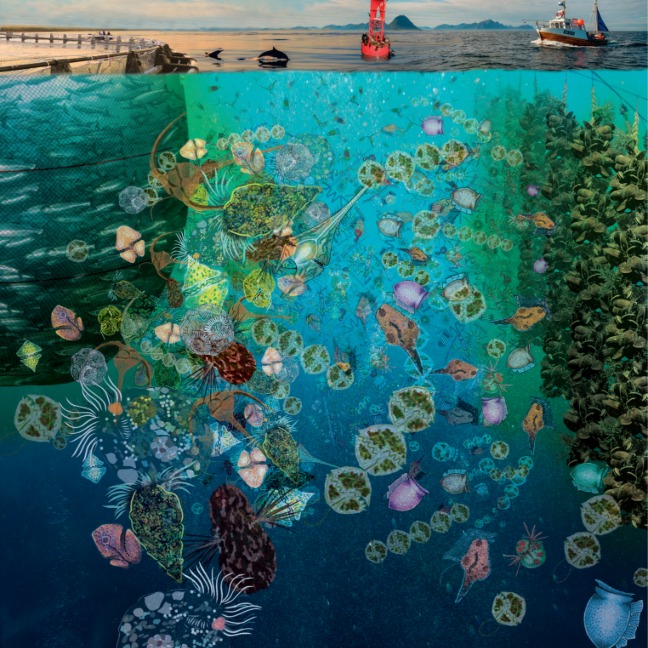
The ambition of this project is to create opportunities for incorporating ocean and water literacy (OWL), including implications of climate change and pollution, into the UK secondary school curricula.
Why?
We owe our existence to organisms that most of us rarely think about: microscopic plankton.
Over millennia, these plankton transformed the Earth’s atmosphere, changing it from conditions similar to those on Venus into an oxygen-rich system that supports life. Today, plankton contribute towards the oxygen we breathe and sustain aquatic food webs, from tiny fish to blue whales.
However, human activities, including climate change, are threatening plankton diversity with adverse effects on the health and sustainability of marine and freshwater resources.
The Making Waves project recognises the vital role of education in fostering ocean and water literacy. We aim to embed key knowledge about plankton ecology, marine and freshwater biodiversity, and impacts of human activities within the UK senior school curricula, across arts, humanities, and sciences.
This will enhance young people’s understanding and appreciation of ocean and water ecology, empowering the next generation to continue the work of conserving and restoring our oceans and freshwaters for the future health of our planet.
How?
- Curricula review: understanding the current context by reviewing the extant GCSE and equivalent curricula across the UK’s devolved nations.
- Policy engagement: exploring opportunities with stakeholders to embed strands of knowledge within facets across the extant (core) curricula from arts and humanities (e.g., English, history) to sciences (e.g., chemistry, biology, geography).
- Resource development: developing innovative, inclusive learning resources through participatory storytelling and by co-creating engaging methods, ensuring that students of all backgrounds and abilities can access the information.
Key project outcomes
- Identify gaps and opportunities in current curricula: Review of UK GCSE and equivalent curricula to identify opportunities for integrating ocean and water literacy (OWL) across all subjects. In doing so, this will equip students of diverse interests with an understanding of the importance of ocean and water ecology for the health and well-being of humans and our shared planet.
- Inform current and future educational policies around curricula development: Publication of a policy brief, informed by an initial stakeholder analysis to ensure that diverse needs and perspectives shape the recommendations. The aim is to showcase holistic connectivity across the curricula while offering clear guidance for implementation and inclusive resource development.
- Develop inclusive and accessible resources: Use novel approaches (e.g., digital storytelling) to co-create content focusing on essential OWL concepts. Particular emphasis will be placed on the impacts of climate change and pollution on UK-centric ocean and water ecology, biodiversity, and sustainability. These resources can inform diverse activities, including Department of Education projects, British Science Association (BSA) CREST project, teachers’ lesson plans and curricula development.
Want to get involved?
If you would like to connect with the project team or have any questions, please reach out to us at enquiries@ukyoungacademy.org.
Members
Leads


Supporting




Project milestones
The following milestones represent the key actions the project team is undertaking as part of the ongoing work.
Mapping the curricula for OWL integration

Stakeholder engagement to inform a policy brief
Developing inclusive resources
Our news in your inbox
Stay up to date on the latest UK Young Academy news and activities.
Related Activities
Health OpenSpaces
Science and Technology Diplomacy
THRIVE